
Albany Court Docket Searches
Start at Indiana Odyssey Public Access, or MyCase. If a notice gives the exact cause number, type it in. Otherwise use the party-name tab. Narrow by Delaware County, filing range, status, court, and case group. Business names usually need an exact match. A trailing wildcard can broaden a starts-with search.
MyCase is a channel, not the official record. Rick Spangler, Delaware County Clerk, keeps Delaware Circuit Court records at 3100 South Tillotson Avenue in Muncie. The office is reachable at 765-747-7726. Once the court prefix is known, call that circuit clerk. Ask before mailing payment or original papers. The county page posts no complete mail-copy process. E-filing submits documents; it does not display a public docket.
- Search the cause number if available.
- Otherwise search a name and select Delaware County.
- Compare party, court, case type, and filing date.
- Read the newest Chronological Case Summary events.
- Request missing or certified documents from the maintaining clerk.
Albany Has No Listed Town Court
The Indiana Administrative Rule 8 and Odyssey lists show no active Albany town-court identifier. Treat that as a routing clue only. It does not mean Albany lacks ordinance enforcement, administrative hearings, citations, or municipal records. It means one thing. Do not invent an Albany court prefix. Do not hunt for a town-branded judicial portal.
Civil, criminal, probate, juvenile, protective-order, or traffic cases filed in Delaware County all start with MyCase. Use the active Circuit Court identifiers 18C01 through 18C05. Muncie City Court's 18H01 is a separate court. Do not pick it just because Muncie is the county seat. The case notice and cause number control where you go.
Inside the Albany Municipal Court
Albany has no active municipal court in the state's own listings. So there is no office to describe here, and no invented one to substitute. Albany Town Hall handles municipal government. Delaware County Circuit Courts handle the county trial matters assigned under local rules.
Use the record type to route. Town ordinance, permit, planning, and council material starts with Albany. A CCS, judicial filing, order, or certified case copy starts with MyCase and the Delaware County Clerk.
A town matter can later become a court case, but only after a filing and a cause number. Keep the municipal notice, citation, permit number, or agency reference handy. Those details help you spot the later court record without mixing up the two files.
Albany's Municipal Record Portal
The official Albany portal publishes town services, notices, meetings, permits, and municipal contacts.
That page is the correct local starting point. It covers an ordinance, planning, council, golf-cart, or town-service question. It is not a judicial case search. If a town page mentions enforcement, first check one thing. Is the event still administrative, or has it drawn a Delaware County cause number?
Albany Town Hall sits at 210 East State Street, Albany, Indiana. Its listed phone is 765-789-6112. For a certified Circuit Court copy, go to the Delaware County Clerk in Muncie, not Town Hall.
Finding Albany Court Dates
A case-specific date shows up in the CCS and related orders. Search the full cause number in MyCase. Read the newest setting line and compare it with the most recent notice, checking the date, time, court, setting type, and location. Old settings stay visible after a reset.
| Date | The scheduled day, subject to later court action. |
|---|---|
| Time | The session or appearance time entered by the court. |
| Court | The active Delaware County division holding the file. |
| Type | Conference, motion, trial, sentencing, review, or another purpose. |
| Change | A continuance, reset, cancellation, or later order. |
If the notice and the online line disagree, call the assigned circuit clerk. A municipal calendar can never stand in for a judicial order.
Albany Council Dates Differ
The Albany About page provides town history and council meeting context.
The schedule on the town site is government business, not a court calendar. Council meetings produce agendas, minutes, and municipal action. Planning meetings produce applications, recommendations, or board decisions. Court hearings produce CCS entries and judicial orders. Similar date formats do not make the records interchangeable.
If an Albany notice says "hearing," look at who issued it. A planning hearing belongs to the town. A hearing with an 18C court number belongs to the assigned circuit court. Keep the document, and ask the named office when the label is unclear.
Albany Traffic Ticket Lookups
An Albany traffic or ordinance event often starts with an agency citation. The citation number, agency reference, and later court cause number can all differ. Use the exact cause number in MyCase when it is printed. Indiana's public traffic-payment search can locate eligible Odyssey matters by its supported fields.
A payment result is not the whole case record. The CCS may show public settings, orders, disposition, and financial events. Some tickets require court action rather than online payment. When no match appears, contact the office printed on the citation. Albany can handle the underlying municipal ordinance record. The listed court or clerk controls the judicial file.
When a notice cites only a town code or golf-cart rule, start with Albany's municipal office. Staff can help identify the underlying record. If staff confirms a court case followed, ask for the citation or cause reference and move to MyCase. That two-step route keeps a local notice from being mistaken for a judicial outcome before any case exists.
Albany Population and Collision Context
Albany counted 2,295 residents in 2020. That figure comes from the official Indiana incorporated-area GIS and Census field. The Indiana Criminal Justice Institute's 2023 county profile reports 46 collisions in town. Neither number measures the court's workload.
Albany's size has nothing to do with where a case lands. Neither does its crash count. A population figure cannot pick a court. A collision tally cannot prove a citation, a charge, fault, or any outcome. Individual matters move through lawful identifiers. The resulting CCS should be read with its official-record limits in mind.
The town's own portal shows the split in practice. Council minutes, planning applications, permits, ordinances, and public notices all become town records. A court filing is different. It produces a cause number and a CCS entry with the Delaware County Clerk. One path can trigger the other. Still, the town file never becomes part of the court file on its own. Ask Albany for the permit or meeting record. Ask the clerk for the pleading or order.
The 46-collision figure is not a ticket count either. One reported crash might end in an agency report. It might end in a citation, an insurance exchange, a civil claim, a criminal investigation, or no public court case at all. The profile gives only an aggregate local signal. For a specific traffic matter, keep the citation number. Search the supported traffic field or MyCase. If a cause number was assigned, use that number. It works for the CCS and the clerk request.
No Albany town-court identifier appears in the Rule 8 and Odyssey systems. That is a strong reason to begin county judicial searches with the active prefixes 18C01 through 18C05. It is not a reason to skip Albany. The wanted record may be an ordinance, planning decision, council action, or golf-cart notice. Call Town Hall and state the record type and date. Contact the Delaware County Clerk with the cause number, court, event date, and document title. Precise requests keep municipal history and judicial action in their own lanes.
How Albany Cases Reach the County
A town issue may remain a permit, ordinance, council, police, or administrative record. Filing is the turning point. Once a legal action is filed, the Delaware County Clerk assigns and records it under the county court structure, and the case receives a uniform cause number. Eligible public events can then display in MyCase.
Docket flow: Albany Notice or Incident › Delaware County Filing › Circuit Court Assignment › CCS Events › Order or Disposition
The filing step is the dividing line. A Town Hall record does not become a court exhibit by itself, and a court CCS may refer to a municipal event without containing every town document. Request each layer separately.
Albany Planning Records and Cases
Albany publishes planning-commission information, permits, and local notices. Those files can document a land-use request or a municipal review. They stay town records unless filed in a court matter. A petition for judicial review or another civil action carries its own cause number. It also carries its own court docket.
| Question | Starting office |
|---|---|
| Permit or application | Albany Town Hall or planning office. |
| Meeting agenda or minutes | Albany municipal records route. |
| Court complaint or petition | MyCase and Delaware County Clerk. |
| Judicial order | Assigned Circuit Court case file. |
| Certified court copy | Delaware County Clerk. |
This split keeps a planning dispute from being described as litigation before any court case exists. The cause number confirms entry into the judicial system.
Who Can See Albany Court Records
Openness is the default in Indiana courts. But some records stay closed. Juvenile cases, sealed material, expunged matters, and confidential personal data may be hidden or redacted under Indiana's Rules on Access to Court Records, and remote access can run narrower than what the clerk may lawfully provide.
No online match is not proof of no record. Recheck spelling, date, court, and type, then ask the clerk about lawful access steps.
MyCase is not the official record. An entry without a link may point to a document the clerk holds. A screen print is not certified either. The Indiana Access to Public Records Act covers agencies broadly, while the judiciary's access rules govern court case records in detail.
Albany Cases in Federal Court
Albany can appear in federal court. The U.S. District Court for the Southern District of Indiana manages such cases through PACER and CM/ECF, its federal docket systems. That court's official court information page identifies the Indianapolis division and the federal docket route.
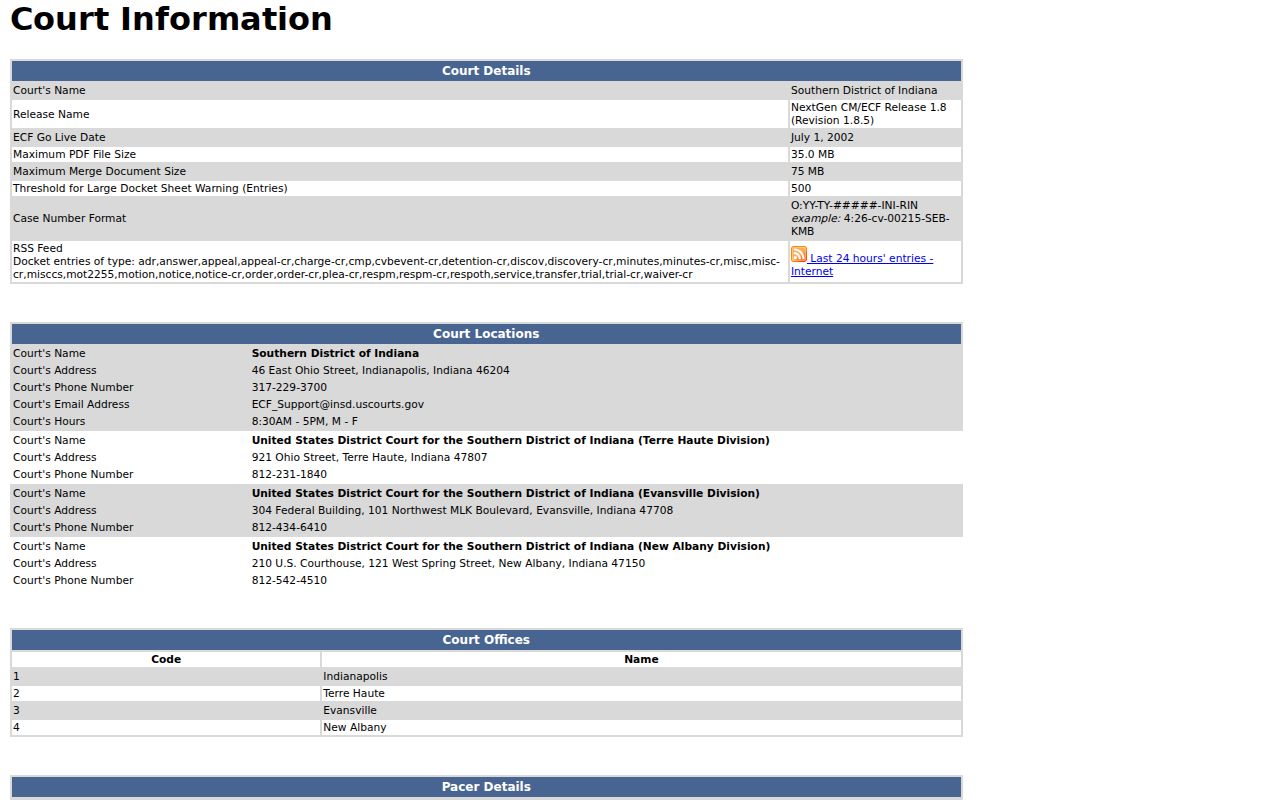
A federal listing confirms a system apart. It does not mean a routine Albany dispute belongs there. Start with MyCase and the Delaware County Clerk. Go federal only if the caption, notice, or court name clearly identifies a federal court. Bankruptcy runs through its own Southern District docket and never through a Delaware County CCS.
Before trusting an Albany result, compare the full cause number, court identifier, filing year, case type, party names, and newest public event. A common name can pull up the wrong case. So can a similar business name. Keep the municipal source with the town question. Keep the county CCS with the judicial question. Keep the federal docket with a federal caption. When a hearing is urgent, call the assigned clerk for a fast answer. For formal proof, request the exact public order or a certified copy. Do not rely on a search summary. That habit keeps each record with the office that created and maintains it.
The town portal still holds the local facts. Permits, ordinances, and planning records live there. Save the date and reference number whenever a later court filing seems likely. The files may relate, but each request goes to the office that keeps it.